
Tyagi has said that in the changing phase of international relations, economic security also becomes vital.
In his book Lashkar-e-Taiba, From 9/11 to Mumbai, author Stephen Tankel points out that the 60-hour terror siege on Mumbai had catapulted the LeT to international notoriety.
Tariq Fatemi, a former Pakistani ambassador to the United States, said President Pervez Musharraf's failure to rout terrorism in Pakistan was largely because he did not have popular support, as the war on terror was seen by the people as 'America's war.'
Retired Commodore Uday Bhaskar, leading strategic analyst, has predicted that the Indo-US relationship 10 years into the future will still remain on track even if the bilateral civilian nuclear deal is not consummated because it is now driven largely by non-government actors.
Leading South Asia experts have assured the United States Congress that the prospect of Pakistan's nuclear arsenal falling into fundamentalist hands is, at least in the short term, unlikely.

South Asia experts have called the recent Obama-Singh meet a success, going by the positive signals given by both sides in all major areas of cooperation, both bilateral and multilateral.
Tariq Fatemi, former Pakistani ambassador to the United States and principal foreign policy adviser to erstwhile prime minister Nawaz Sharif, has urged New Delhi to lift the 'pause button' on the Indo-Pakistan composite dialogue, which was imposed after the Mumbai terror attacks.
'Lashkar clearly poses the greatest danger to India,' says Stephen Tankel, author of a book on the Lashkar-e-Tayiba.

Terming United States President Barack Obama's maiden trip to India as a triumph, noted American experts cutting across ideological spectrum on Monday said that it has taken the Indo-US relationship to an altogether new level.
David C Mulford, who will soon vacate his post as United States'ambassador to India, has urged the Obama administration to ensure the implementation of the India-US civilian nuclear agreement.In an interaction at the Carnegie Endowment for International Peace in Washington, Mulford said, "The nuclear deal may be completed, but the work isn't done. There is unfinished business there to be done."
Strategic affairs specialist Ashley Tellis believes the November 26 terror attacks on Mumbai has given birth to the "misguided notion" that a resolution of the Kashmir dispute is imperative to rein in terrorism in South Asia, and that this should be the priority of the proposed special envoy to the region.
At a seminar in Washington, DC, the consensus among a high-profile group of former diplomats, military leaders, politicians, businessmen and others was that the Mumbai terror attacks was a tangible manifestation of a global threat that calls for a global response.
India is not only the world's largest democracy, it is also a powerful model for other emerging democracies, a top United States official said on Wednesday.India is a model of tolerance and of strength in diversity, Under Secretary of State for Political Affairs William J Burns said. He pointed out that the bilateral ties between the two countries had 'come a long way'.

When a media person asked why despite the affinity the United States had such a hard time endorsing India's bid for a permanent seat in the United Nations Security Council, Burns went into a spin.
Ahead of the crucial Itentaional Atomic Energy Agency meeting on Friday, a group of arms control experts has urged both the atomic watchdog and Nuclear Suppliers Group to look at the Indo-US nuclear deal 'very carefully and remove all ambiguities'.

United States President-elect Donald Trump on Saturday warned BRICS countries against any move to replace the US dollar and has sought a commitment from the nine-member group that includes India, Russia, China, and Brazil.
Ashley Tellis denies saying that the US 'got more from the government of Dr Manmohan Singh.' rediff stands by the interview.
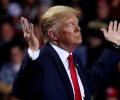
In his Diwali greetings on Thursday, Trump strongly "condemned the barbaric violence against Hindus, Christians, and other minorities in Bangladesh", which he said remains in a "total state of chaos."
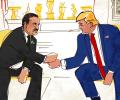
'Trump has personally weighed in to overcome doubts and reservations about Pakistan among his top advisors.'
Kanwal Sibal, in a speech at the Carnegie Endowment for Peace, said Pakistan has reneged on its pledged to end terror.
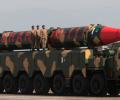
Asserting that Pakistan developing sophisticated missile technology will give it the capability to strike targets well beyond South Asia, including in the United States, a top White House official said on Thursday that the Asian country's actions are an emerging threat to the United States.

With these propositions in mind, India started "some exploratory discussions" he said, adding that it started during Prime Minister Narendra Modi's visit to Italy during G-7, and then during his visit to Moscow.


'...it should not delude itself into thinking that India's security or its great-power ambitions will be advanced by those partnerships.'
'Instead, what India should focus on is on riding out the next three-and-a-half years of Trump's presidency with minimal damage to itself.'
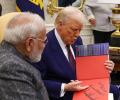
'The current strain in the relationship is serious and likely to be long lasting.' 'Even if Trump suddenly changes his attitude toward India -- which he is entirely capable of doing -- it is unlikely that New Delhi will be able to pick up the pieces and respond as if nothing has happened.'
'Pakistan is no longer a front-burner issue for America.'

In a warning sign for the Democrats, Indian-Americans' attachment to the party is declining in the United States while the share of Republican identifiers held steady.
Indian-Americans have relatively more conservative views of policies in India while on issues affecting the US, the diaspora has a more liberal take, according to a survey of the political attitudes of the influential community in this country.

Finance Minister P Chidambaram has supported Civil Aviation Minister Ajit Singh's suggestion on doing away with a rule that bars Indian carriers from flying abroad unless they complete five years of service and own a 20-aircraft fleet.

'Fears in Washington began to intensify when it was realised that subsequent Pakistani and Indian attacks on major military facilities -- which were significant in terms of geographic scope and intensity -- could rapidly take both sides to where neither actually wanted to go.' 'The US objective was to stop the fighting as soon as possible. Everything else was secondary.'

The Bihar assembly elections in October will be the biggest electoral test for Prime Minister Narendra Modi so far, scholars from a top American think-tank have said, noting that the ramifications of its results will be felt far away from the state's borders.

The 'aura of invincibility' around Prime Minister Narendra Modi has been 'shattered' by the Indian voters who gave the Opposition a new lease on life, this is how the international media described the outcome of India's general elections.
